Our Publications
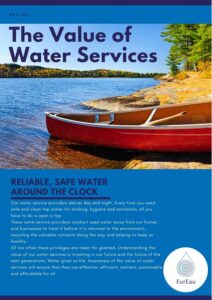
The Value of Water Services
Our water service providers deliver day and night. Every time you need safe and clean tap water for drinking, hygiene and sanitation, all you have to do is open a tap.
These same service providers conduct used water away from our homes and businesses to treat it before it is returned to the environment, recycling the valuable nutrients along the way and helping to keep us healthy.
All too often these privileges are taken for granted. Understanding the value of our water services is investing in our future and the future of the next generations. Water gives us life. Awareness of the value of water services will ensure that they are effective, efficient, resilient, sustainable and affordable for all.

Briefing Note on Integrated Management Plans
Local solutions to managing investment and maintenance needs of waste and storm water will protect people and the environment in an environmentally sustainable and financially feasible way. Integrated waste water and storm water management plans may provide waste water operators and urban planners with a strategy for managing water in the urban environment. Local solutions to managing waste water and storm water systems allow people and the environment to be protected.
EurEau Annual Report 2020
What did EurEau get up to in 2020? Read on to find out, and what 2021 brings us!
EurEau response to NIS (Security of Network and Information Systems) review
The current directive is just being implemented, and so there is little or no experience as to how it functions in practice. Instead of revising, should the Commission focus on its effective implementation.
If the European legislators decide to proceed with the revision, they should focus on the further development of a coherent and streamlined regulatory framework for the security of network and information systems, without imposing additional and excessive burdens on industry.
At the same time, any duplication of legislation and inconsistencies with existing sector-specific and digital EU law should be avoided. The revision of the Directive should lead to a further strengthening of the preventive approach. This includes all aspects of detection and recovery by providing more and more detailed information on risks and incidents in the Member States, from national competent authorities to operators of essential services.

Briefing Note on nutrients and waste water management
This briefing note on nutrients and waste water management summarises how nutrients are currently managed within waste water and proposes ideas about the future of nutrient management within waste water management.
Position paper on the Precautionary and Innovation Principles
In the framework of new Commission policy work to protect public health and the environment, certain sectors, and in particular the chemical industry, are promoting a new ‘Innovation Principle’ next to the Precautionary Principle.
Position Paper on Best Available Techniques Reference Documents (BREFs)
EurEau strongly supports innovation in our sector. However, we do not agree that the approach of BREFs as defined under the Industrial Emissions Directive (IED) suits the context of the UWWTD. Innovation and affordability of water services are best supported by an UWWTD which establishes output requirements with clear indications of enhanced performance requirements to achieve specific protection of the environment and public health, rather than prescribed instruments.

Briefing Note on Drinking Water Supply and Leakage Management
Effective asset management of water supply infrastructure and management of water losses from the distribution system are critical parts of the water suppliers’ role.
An agreed EU framework for calculating a water balance is a critical first step in leakage management under the 2020 Drinking Water Directive. Leakage reduction is a tool for addressing water scarcity in many parts of Europe, cuts Greenhouse Gas emissions and resource use. The water sector is committed to reducing these to enhance sustainability.

Briefing Note on sludge management
The current regulatory framework for sludge is set across a number of different instruments at EU level, which tend to focus on the waste dimension rather than on the reuse of the valuable resources. Waste water operators already render the valuable resources found in sludge to be reusable. However, a regulatory framework is needed to support sustainable and resilient sludge management, incorporating a broader scope for risk assessment and strict sludge quality control.
This briefing note details the current arrangement for the management of sludge that comes from waste water treatment. It will inform the reader of the existing solutions for sludge and gives a sound vision of the future and appropriate directions. It is based on EurEau members’ experience as waste water operators.

Briefing Note on PFAS and Waste Water
PFAS are a group of contaminants that have gained increased attention due to their potential to bio-accumulate, their environmental persistence, potential toxicity and, for many of them, high water solubility. They have been found in all environmental compartments, including wildlife and humans. Studies have identified waste water treatment plants as a pathway for PFAS to the environment. PFAS are a growing concern especially in relation to water resources used for the abstraction of drinking water.
Preventing PFAS from entering WWTP through control-at-source measures is the only way to avoid PFAS from being released to the (aquatic) environment through this pathway. A ban of all non-essential uses might be a first step. However, a coherent regulatory framework with clear instruments covering all persistent, mobile, toxic (PMT) and very persistent, very mobile (vPvM) substances needs to be in place to prevent and limit the emission of these substances to the water cycle.