Our Publications

Briefing Note on Sludge and the circular economy – the impact of PFAS
This briefing note describes the various pathways PFAS can take to accumulate in air, soil and plants. It identifies the main contributors of PFAS in waste water and how PFAS can end up in sewage sludge. We demonstrate how only a full PFAS ban can allow for the inclusion of sewage sludge in the circular economy through agricultural application and incineration while encompassing the nutrient recycling potential.
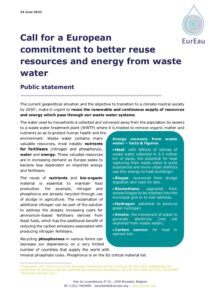
Public statement – Call for a European commitment to better utilise resources and energy from waste water
The current geopolitical situation and the objective to transition to a climate-neutral society by 2050, make it urgent to reuse the renewable and continuous supply of resources and energy which pass through our waste water systems. Waste water contains many valuable resources, most notably nutrients for fertilisers (nitrogen and phosphorus), water and energy. These valuable resources can be recovered and reused, making a significant contribution to the circular economy.

EurEau Annual Report 2021
It was another busy year for EurEau, with drinking water, PFAS, plastics, waste water, taxonomy and innovation high on our agenda. Read about our work in our annual report.

Open letter from 79 organisations on the EU reform of pesticides statistics 25.02.2022

Position paper on PFAS in the urban water cycle – Dec 2021 update
Removing PFAS from the urban water cycle causes a wide range of problems for water service providers. While technologies exist to remove most PFAS, they are unsustainable, mainly due to their technical complexity, resource intensity (water, energy, treatment chemicals etc.) and the generation of PFAS-containing residues. Reliance on end-of-pipe solutions creates a substantial stumbling block on the water sector’s journey towards climate neutrality. Any emissions of chemicals belonging to this group into the environment need to be avoided, using the Precautionary Principle and the Control-at-Source Principle. This can be best achieved by an EU-level ban of all PFAS uses.

Position paper on the Renewable Energy Directive
Although the Renewable Energy Directive (RED III) does not specifically address the water sector, the water cycle has renewable energy generation potential, i.e.: the generation of electricity from hydraulic turbines, biogas from sewage sludge, electricity and thermal energy from sewage sludge mono-incineration, electricity from on-site windmills and solar panels, heat pumps and thermal energy from waste water at several stages of the water cycle. Hence, the water sector substantially contributes to the renewable energy targets and climate policies.
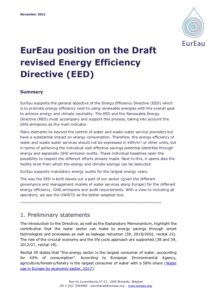
Position paper on the Energy Efficiency Directive
EurEau supports the general objective of the Energy Efficiency Directive (EED) which is to promote energy efficiency next to using renewable energies with the overall goal to achieve energy and climate neutrality. The EED and the Renewable Energy Directive (RED) must accompany and support this process, taking into account the GHG emissions as the main indicator.
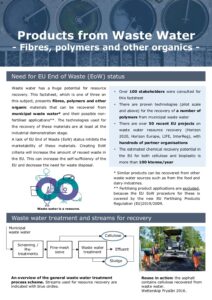
Factsheet on products from waste water – fibres and polymers
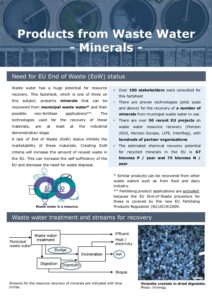
Factsheet on products from waste water – minerals
