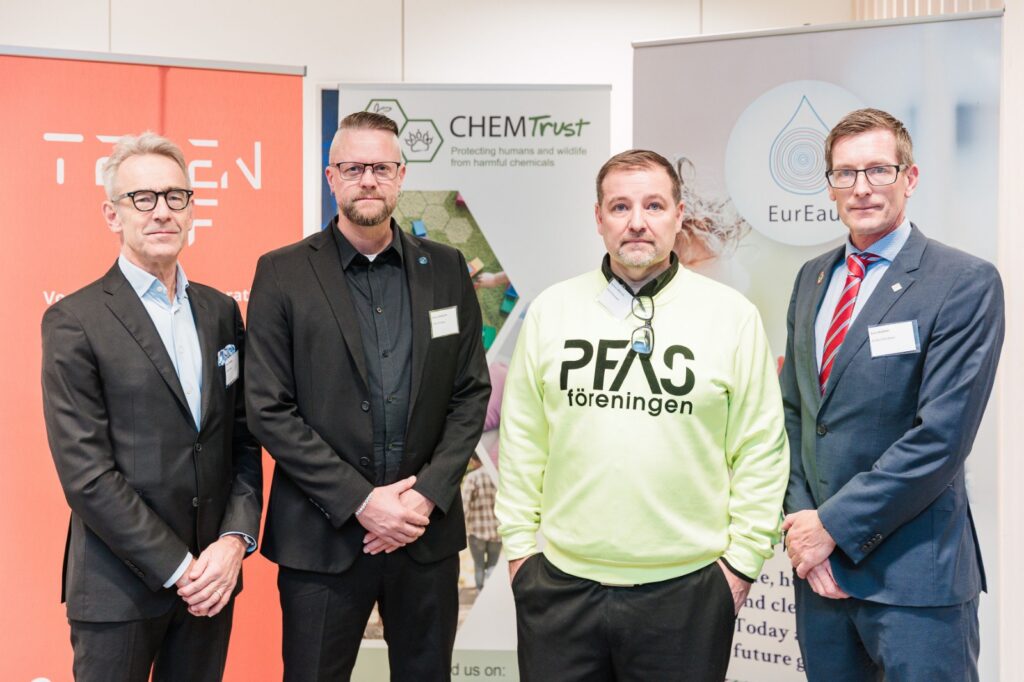
How can Europe accelerate the development and uptake of PFAS-free alternatives? This was the central question at a conference hosted at the European Parliament in Brussels on 12.11.26, Unlocking PFAS-free innovation for a healthy and competitive Europe.
Hosted by the Permanent Representation of Belgium to the European Union, represented by Peter Moors, with the support of Jean-Luc Crucke, Federal Minister of Climate, Ecological Transition and Sustainable Development, the conference was organised by CHEM Trust, Tegengif and EurEau.
It brought together high-level politicians, Member State representatives, EU decision-makers, businesses, medical professionals, water service providers, civil society, journalists and public health experts, including representatives from the European Cancer League. Discussions focused on the availability and development of PFAS-free alternatives in sectors including healthcare, drinking water and green technologies.
The message was clear: PFAS use is not inevitable, and alternatives are possible.
A decisive moment for Europe’s PFAS policy
The conference comes at a pivotal moment for European chemicals policy. Following years of scientific assessment and policy development, the proposed EU-wide PFAS restriction is approaching a decisive phase. ECHA’s scientific committees are working towards finalising their opinions, while the European Commission is preparing the next steps in the decision-making process.
The decisions taken in Brussels over the coming months will shape Europe’s approach to PFAS for decades. It is therefore essential to demonstrate that safer alternatives are already available in many applications and that further innovation can be accelerated.
Clear rules can drive innovation
Europe has an opportunity to lead the transition away from unnecessary PFAS use while strengthening its industrial competitiveness and protecting public health and the environment.
Across a growing number of sectors, businesses and researchers are developing and implementing PFAS-free solutions. Their experience shows that moving away from these substances is achievable. However, innovation and investment need a clear direction.
A broad PFAS restriction can provide precisely that. Clear rules, a credible timeline and a defined end goal give businesses, researchers and healthcare institutions the regulatory certainty they need to invest in alternatives, develop new technologies and scale up existing solutions.
Exemptions should remain limited to genuinely essential uses where suitable alternatives are not yet available, rather than becoming a reason to delay the transition.
Preventing pollution at source
For Europe’s water services, reducing PFAS pollution at source is particularly important. Once these persistent substances enter the water cycle, removing them from drinking water can be technically challenging and costly. Treatment is not a substitute for preventing pollution in the first place.
The costs of tackling PFAS contamination should not be passed on to water consumers or water service providers. Those responsible for pollution must bear the costs of preventing and addressing it, in line with the Polluter Pays Principle.
Europe must seize this opportunity to make PFAS-free innovation the norm, not the exception. A strong and ambitious restriction, supported by investment in safer alternatives, will help protect public health and the environment while giving European industry the certainty it needs to innovate and remain competitive.