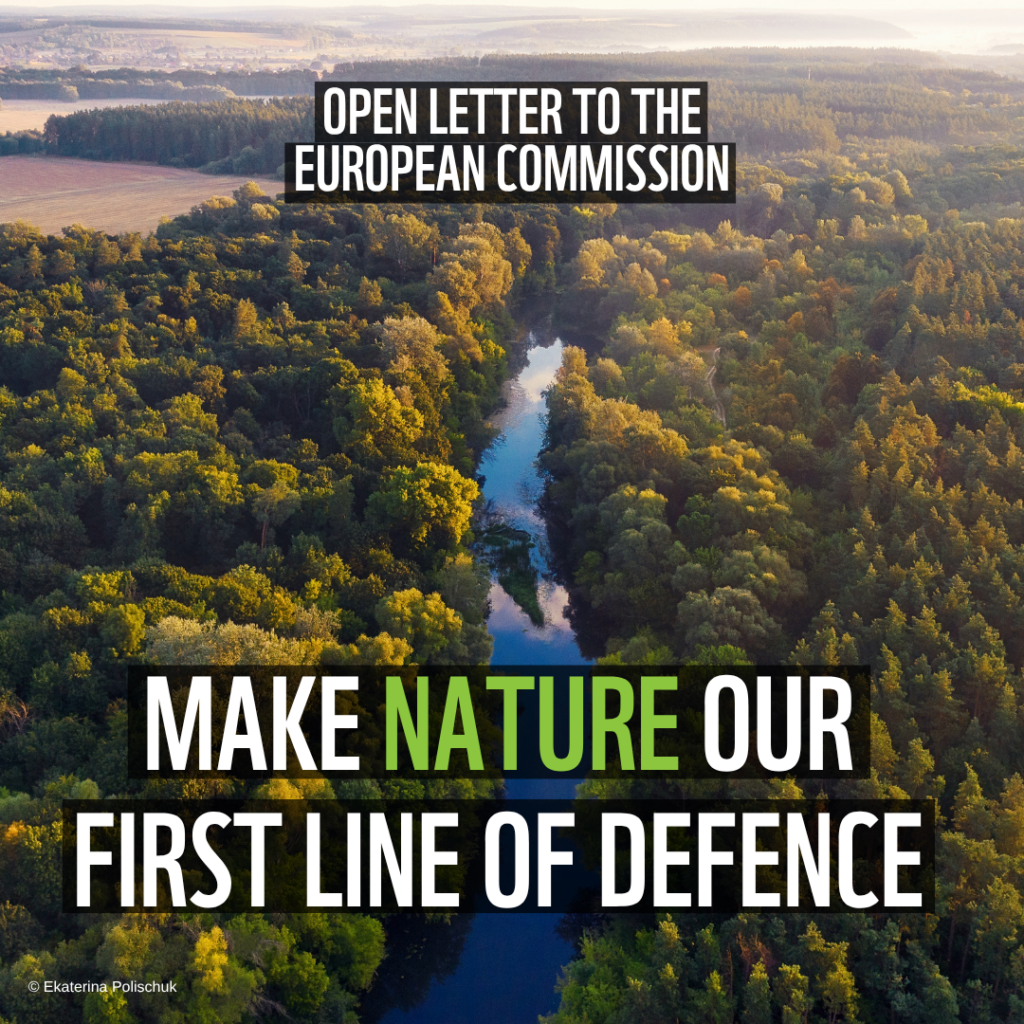
After a deadly summer, 30+ organisations tell the EU: make nature our first line of defence
Over 30 organisations are asking the European Commission to make nature-based solutions a systemic priority in the upcoming legislative proposal of the European Framework for Climate Resilience.
Two days ahead of the State of the European Union address, over 30 organisations representing sustainable farmers, water providers, healthcare providers, local authorities, citizens as well as financial service providers have written to President Ursula von der Leyen urging her to prioritise nature-based solutions as the first line of defence against climate disasters and to translate that ambition into in the upcoming European Framework for Climate Resilience.
The letter follows a summer that broke heat records and exposed, once again, how unprepared Europe is for the climate it already has. Western Europe felt its hottest June-July period since records began, with exceptional wildfires ravaging thousands of hectares across the continent. [2] [3]
The human cost has been stark. At least 35,000 excess deaths have been recorded across Europe during this summer’s back-to-back heatwaves, though the true figure is likely far higher, since these estimates do not include August. The economic and infrastructure toll has been just as revealing.
“Europe’s recent summers have shown that climate resilience can no longer be treated as a problem for the future. The Commission has acknowledged the vital role that nature-based solutions play in protecting communities and ecosystems from climate disasters. With the interservice consultation on the European Framework for Climate Resilience expected to begin before the end of September, now is the moment to ensure that this recognition is translated into the legislation itself,” said Claire Baffert, Senior EU Policy Officer, Water & Climate Change Adaptation at WWF EU on behalf of 30+ signatories. [5] [6]
In her State of the Union speech last year, President von der Leyen noted that climate change is making each summer hotter, harsher and more dangerous, and that Europe must radically step up its efforts on climate resilience, adaptation and nature-based solutions. In July, she wrote in response to MEPs that nature-based solutions play an essential role in adapting to climate change by strengthening resilience to heatwaves, droughts and floods. [4]
The signatories call on the European Commission to turn its rhetoric on nature-based solutions into law, by reflecting that commitment in the legislative proposal.
[1] The open letter, Make nature-based solutions the first line of defence against climate hazards, and the full list of signatories are available here.
[2] Copernicus Climate Bulletins: https://climate.copernicus.eu/climate-bulletin
[3] Excess mortality figures as reported by The Guardian, 25 August 2026: https://www.theguardian.com/environment/2026/aug/25/at-least-35000-excess-deaths-europe-back-to-back-heatwaves
[4] Letter from European Commission President Ursula von der Leyen to Members of the European Parliament on financing the Nature Restoration Regulation, 30 July 2026, published by POLITICO, 2 September 2026
[5] Strengthening resilience to climate change – Recommendations for an effective EU adaptation policy framework, European Scientific Advisory Board on Climate Change, February 2026: https://climate-advisory-board.europa.eu/reports-and-publications/strengthening-resilience-to-climate-change-recommendations-for-an-effective-eu-adaptation-policy-framework
[6] Natural water retention in practice:
In the Netherlands, the Room for the River Programme restored the Geul river’s dynamics by constructing a side channel along the Waal near Nijmegen to allow the river to overflow, creating both recreational and nature areas as well as a city island.
In Germany, the relocation of a dyke along the river Elbe created a new retention area with a diverse floodplain, including alluvial forests, half-open pasture landscapes and other typical habitats of lowland floodplains. Since the cutting of the old dyke in 2009, the measure proved effective during several high-water events. Source: WWF, Rivers2Restore Report, June 2024: https://wwfeu.awsassets.panda.org/downloads/rivers2restore-report_v6-0.pdf